
Building a Midlife Practice
What 100 Days Can Teach You About Yourself

I’m a little embarrassed to share this. But here goes.
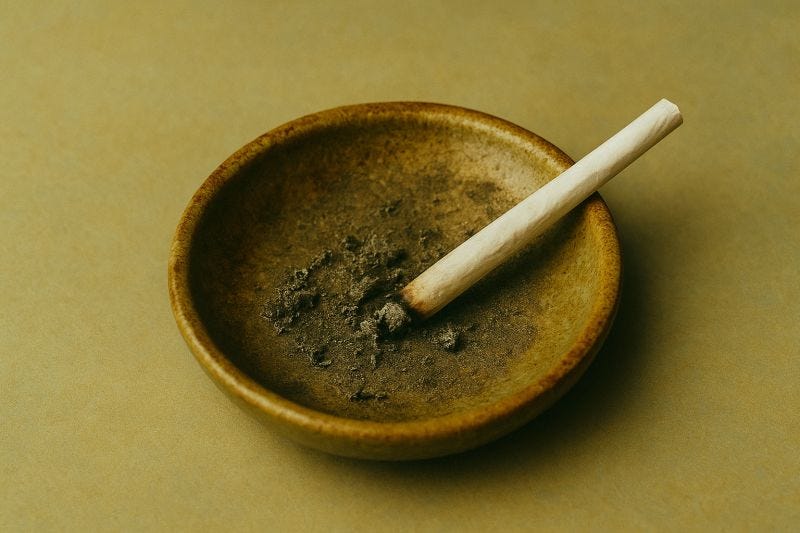
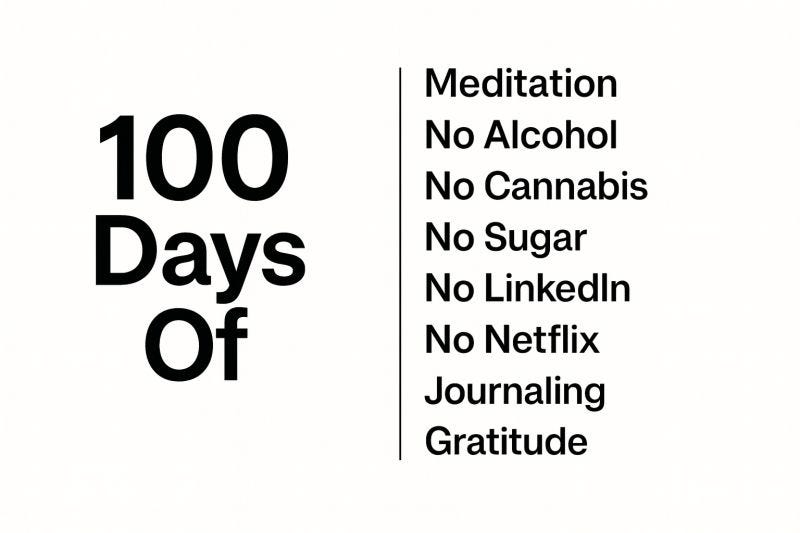
Last fall, I took a 100-day pause from cannabis. For some people, that sounds small. For me, it was everything. The longest break I’d taken in, gulp, thirty years.
The hiatus began after a less-than-enjoyable experience at a concert in Boulder. I got anxious and left the show before it was half over. Something had shifted. The relationship had become unhealthy.
I was asking it to do things I didn’t want it to be responsible for. My creativity. My calm. My focus. Sometimes I’d nibble a gummy before a run. I never thought of myself as someone with a problem. But I’d started relying on it more than I cared to admit.
So I stopped. For 100 days.
In midlife, we like to convince ourselves we’re too set in our ways to change.
We say things like “I’m not a morning person” or “I’ve never been able to stick to anything,” as if these are fixed truths rather than stories we’ve repeated long enough to believe.
But here’s what’s actually true.
You already have dozens of practices you built without ever calling them that.
You brush your teeth. You make coffee. You check your phone. You make your bed each day, or you choose not to. Either way, it’s a practice.
You’ve wired yourself in hundreds of ways you barely notice anymore.
So the question isn’t whether you can build a new practice.
You’ve been doing it your whole life.
The question is whether you can do it consciously.
This matters most when you’re reinventing yourself.
The people I work with are navigating real identity shifts. Leaving careers they’ve outgrown. Letting go of titles that once defined them. Trying to build something new without a roadmap.
One of the first things I tell them is this:
Identity doesn’t change through declarations. It changes through repetition.
Every small action is a vote for the person you’re becoming.
A hundred days of votes starts to look like a different life.
The 100 days taught me a few things I didn’t expect.
The first was discomfort. Without anything to smooth the edges, I had to sit with the anxious moments rather than soften them. I had to notice how scattered I can feel. I had to trust that my creativity would still show up without a chemical nudge.
It did. It just needed space.
The second thing: I got an ADHD diagnosis at 52. Turns out I’d spent thirty years self-medicating something that needed actual attention. That diagnosis was its own Second Act moment. Seeing myself clearly for the first time. Realizing the fog I’d been managing wasn’t a character flaw. It had a name. And once it had a name, I could actually do something about it.
The third: watching someone else do it first gave me a roadmap. My wife Rachel had done a couple of 100-day alcohol pauses before giving up drinking entirely last year. She approached each one with honesty and intention. No drama, no grand announcements. Just a quiet decision and a container of time.
Her blueprint gave me the courage to try my own version.
A 100-day pause is not a forever commitment.
That’s the whole point.
You’re not swearing off anything. You’re not becoming a different person overnight. You’re just creating enough distance from a habit to see it clearly.
To ask what it’s actually doing for you.
To notice what’s underneath it.
The pause itself is the experiment.
Rachel and I have kept using the 100-day structure.
She recently finished 100 days of running exactly one mile a day. (She missed one or two, but give her a break — those days were frigid.)
Earlier this year, we invited a handful of people to join us for a shared round. Each person chose their own thing: no alcohol, no sugar, daily exercise, no screen time after dinner.
The habits were individual. The container was shared.
Something about doing it alongside others made it stick in a way that solo willpower struggles with.
A study by researcher Phillippa Lally, published in the European Journal of Social Psychology, found that habit formation takes an average of 66 days.
The full range ran from 18 to 254 days, depending on the person and the behavior.
100 days sits right in the middle. Long enough to matter, short enough to commit to.
So here’s a question.
What might your 100-day experiment look like?
Not a life overhaul. Not a grand declaration.
Just a small daily practice.
I recently invited my Second Act coaching group to try something simpler: one micro-habit for seven days. I chose walking around my block each morning before checking my phone. Listening to the birds wake up.
My routine was going beautifully until I missed two days because of a colonoscopy. Such is midlife.
Yesterday, I reset.
Five minutes outside each morning before I look at my phone. For 100 days. That’s my goal, at least. I’ll let you know how it goes.
Birds recorded on yesterday’s walk. Louisville, Colorado, May 5, 2026.
The key is to make the practice small enough that you can’t talk yourself out of it on a hard day.
And if you miss one?
It happens. Fortunately, Lally’s research found that missing a single day has no meaningful impact on habit formation.
You just pick it up again the next day.
I’ll leave you with this.
What new practice are you being called to try?
Or what’s one you might be ready to step away from?
Something small enough to start this week.
Meaningful enough to matter in a hundred days.
You don’t need to know exactly where it leads.
You just need to be curious enough to begin.
If you have an idea, I’d love to hear it.
In the meantime, I’m off to hear the birds.
Dan 🤙