
The Problem-Solving Era
Or: why the most valuable skill of the next decade has nothing to do with coding

A lot of us feel it.
The wave building on the horizon. The ambient hum of AI everywhere, all at once. The question that keeps surfacing, sometimes in the middle of the night:
Should I be doing something with this?
And then, almost immediately, the paralysis.
Which tools? Which tutorials? Which skills? What on earth do I even build?
I coach professionals in career transition, and this particular flavor of overwhelm is one I see constantly. People who are sharp, curious, capable, and accomplished. People who’ve spent decades building expertise in their fields.
And yet they’re standing at the edge of this enormous moment, unsure whether to jump in, and if so, where.
So I’ve started asking a different question.
Not “What skills do you want to learn?”
Not “Which AI tools have you tried?”
Instead:
What’s the biggest problem in your life right now that you wish you could solve?
That question tends to stop people.
Because it reframes everything.
The entry point into this new world doesn’t have to be technical. It can be deeply personal.
Let me tell you about mine.
I have myasthenia gravis, an autoimmune disease that affects the neuromuscular system. I also love to run.
Over the past three years, I’ve completed two marathons, which still feels surreal to type out.

But I’ve spent these three years in a state of genuine uncertainty about how hard to push.
Exercise is unambiguously good for me. It also has the potential, if I get it wrong, to trigger a flare.
If one end of the spectrum is running 20 miles a day and the other is never leaving the couch, I’ve been trying to figure out where exactly I belong on that line, and what the cost of misjudging it might be.
It’s the kind of problem that lives in the background. You don’t solve it, exactly. You just carry it.
Recently, I started approaching it differently.
Not with my neurologist. Not with Google or Reddit.
But by having a dialogue with Claude.
A conversation, the way you’d talk through a problem with a knowledgeable friend who happened to have read, well, pretty much everything ever written about autoimmune disease and exercise physiology.
I described my history, my condition, my goals. I asked:
What data would actually be useful here?
What would a personalized system even look like?
That thread grew into something I didn’t expect.
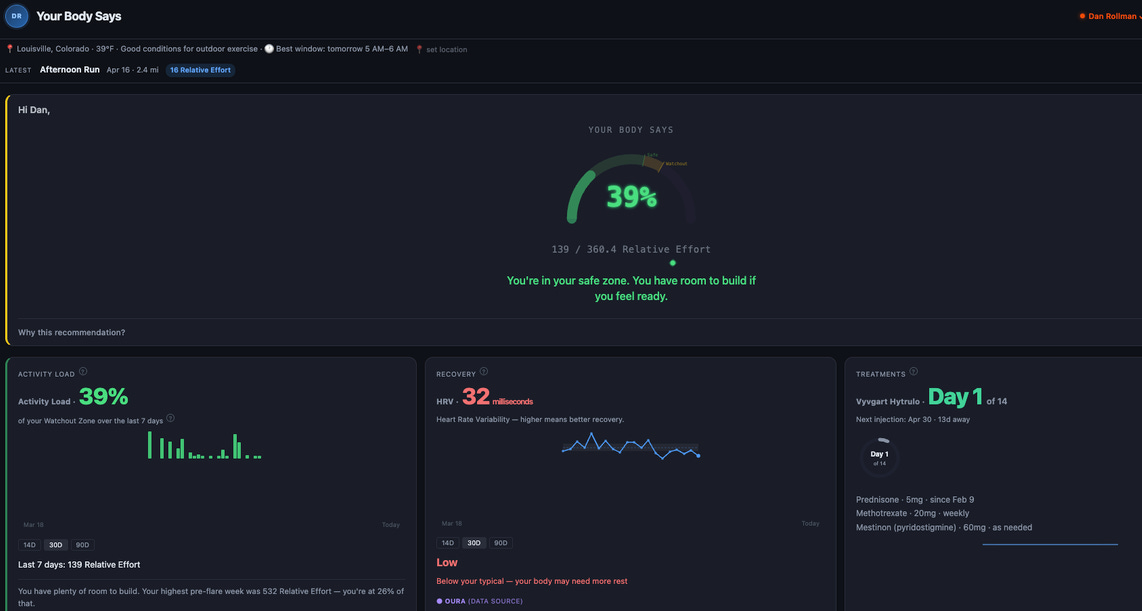
Over several focused sessions with Claude Code, I built a working prototype of something I’m calling Your Body Says.
I am not a developer. I’ve never written a line of code.
And yet.
The system pulls in data from Strava, Apple Health, and my Oura Ring. It incorporates years of doctor’s notes and medication history. Each morning, it synthesizes all of that into a simple question:
Is today a good day to run?
I built this. That still feels strange and amazing to write.
I’m not sharing this to brag about a side project. I’m sharing it because of what the experience revealed, both about these tools and about what I believe is coming next.
I think we’re entering a Problem-Solving Era.
For most of the 20th century and well into the 21st, the default path for ambitious people looked something like this: get credentialed, get hired, climb. Find a large organization that had already identified the problems worth solving, and apply your skills within that structure. The problems were given to you. Your job was execution.
That model is fracturing. Not just because of AI, though AI is accelerating it significantly. Entry-level roles at large companies are already contracting. The ladder that previous generations climbed is getting shorter. A lot of the people I work with in career transition aren’t just between jobs. They’re between paradigms.
What’s replacing it is something more interesting, and more demanding.
The AI of today is far from perfect. It hallucinates like an overtabbed Deadhead. It gets things ridiculously wrong. It needs to be guided, corrected, and pushed.
But it is already enabling curious and entrepreneurial people to build meaningful, profitable companies with teams of 1 to 5 people. Technical constraints that would have stopped a non-developer cold five years ago are largely gone. You can build now. Not perfectly, not without friction, but you can build.
Which means the scarce resource is shifting. It’s no longer “can you code?” or even “can you manage engineers?” The question that will increasingly separate people is:
Can you identify the most meaningful problem to work on?
This is not a technical skill. It is a human one. It requires self-knowledge, curiosity, and the ability to look at the texture of your own life and the lives of those around you, and to notice what’s missing, what’s broken, and what’s being tolerated when it doesn’t have to be.
We are surrounded by small problems we’ve quietly accepted as unsolvable. Things we’ve just learned to live with. That is changing, and faster than most people realize.
I want to be clear: I don’t think everyone will choose to go this route, or should. There are plenty of ways to engage meaningfully with this moment that don’t involve building software or starting companies.
And the hype around AI is real enough to warrant healthy skepticism. (I’ll write more about “intentional unplugging” soon.)
Many of the professionals I work with, navigating career transitions in their 40s and 50s, have something younger builders don't: decades of accumulated expertise, hard-won judgment, and a long personal list of problems worth addressing.
For them, this moment is a blue ocean opportunity.
The builders who will thrive in the next decade won’t necessarily be the ones who learned to code fastest or adopted the most tools.
They’ll be the ones who asked the most interesting questions. Who looked at their own life, or their industry, or their community, and said: this problem is worth solving, and I’m going to be the one to solve it.
That instinct, to see a gap and move toward it rather than away from it, is something I explore with clients all the time. It’s at the heart of what many Second Acts are about. Not just finding a new job, but finding a new frame. Reorienting around what you want to build, for whom, and why.
The wave is real. You don’t have to know how to surf to get in the water.
You just have to find your problem.
What problem have you been quietly carrying that might be worth exploring? I’m sincerely curious to hear it. Hit reply or drop it in the comments.
This is so great, Dan. First, I love that you’re a “coder” now. Second, this idea of being in the problem-solving era is fully spot-on. We have the most powerful tools at our disposal and we should all feel invincible. I hope you don’t mind, but I’m gonna add you and your app project to the end of my workshop!
A related project and thought process from Charlie O'Donnell https://www.thisisgoingtobebig.com/blog/2026/4/27/your-own-customers-will-disrupt-you-with-ai